01 Around the Plaza
Everything in this cluster is within a ten-minute walk of the bandstand, which makes it the right place to spend a first day while your body works out what 7,199 feet means.
The Palace of the Governors and the New Mexico History Museum behind it hold the through-line of the whole region, from Pueblo prehistory to the Santa Fe Trail. Under the Palace portal, the juried Native American Vendors Program sells direct from the maker. Diagonally opposite, the New Mexico Museum of Art occupies the 1917 building that effectively wrote the rulebook for Spanish-Pueblo Revival; the museum also runs a contemporary space in the Railyard, so check which address holds the exhibition you want.
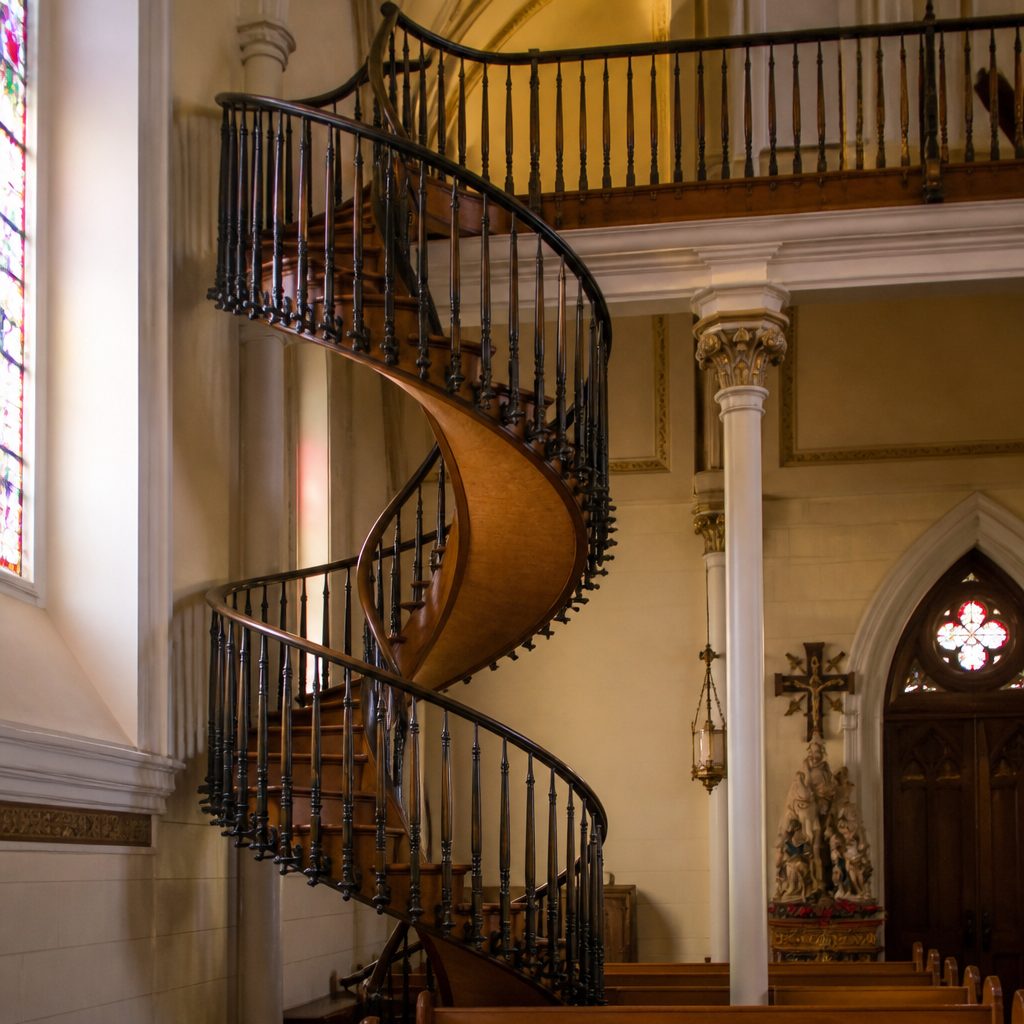
Two blocks east, the Cathedral Basilica of St Francis of Assisi is a French Romanesque building begun in 1869, complete with a chapel holding La Conquistadora, a small carved Marian figure brought north in 1625 and generally described as the oldest such statue in the country. A block south, Loretto Chapel is a small Gothic Revival chapel, privately run and ticketed, known almost entirely for a helical wooden staircase built without a visible central support. On Old Santa Fe Trail, San Miguel Chapel claims the title of oldest church structure in the continental United States, with walls dating from the first decades of the villa and substantial rebuilding after 1680.
The Georgia O'Keeffe Museum, a short walk northwest on Johnson Street, holds the largest collection of her work anywhere. It also administers the ticketed tours of her home and studio in Abiquiú, an hour north, which are limited in number and sell out well ahead: see the lead-time table.
02 Canyon Road and the galleries
Canyon Road runs east from Paseo de Peralta up a shallow valley, and for roughly half a mile it is close to solid galleries: something on the order of eighty to a hundred of them, in old adobe houses with courtyards, sculpture in the gardens and, in most cases, an open door.
The practical advice is short. Park at the bottom, on Paseo de Peralta or in the streets below, and walk up. Parking gets worse and more contested the further up you go, the lane is narrow, and the climb is gentle enough that walking it costs nothing. Galleries generally open late morning and close around five. Friday evenings are the traditional opening nights, when the doors are open later and the road is at its liveliest.
Keep going past the galleries and Canyon Road turns into Upper Canyon Road, which ends at the Randall Davey Audubon Center, a preserve of about 135 acres at the mouth of the canyon with short trails and a great deal of birdlife. It is the quietest thing within two miles of the Plaza.
On one night a year
On Christmas Eve, Canyon Road closes to traffic and fills with farolitos, small paper lanterns weighted with sand, set along every wall and roofline. It is the single most crowded evening on the street and worth planning around either way. The events chapter explains the difference between a farolito and a luminaria, which locals will correct you on.
03 Museum Hill
Two miles southeast of the Plaza on Camino Lejo, four museums and a botanical garden share one plaza and one parking lot. It is the strongest single concentration of collections in the state and the most under-visited, because it is just far enough to need a car or the city bus.
Museum of International Folk Art
The largest collection of folk art in the world. One hall alone holds roughly ten thousand pieces from Alexander Girard's collection, staged as toy villages you walk through. Allow two hours and take children.
- Museum Hill
- Two hours
- State museum
Museum of Indian Arts and Culture
Pottery, weaving and jewellery of the Southwest presented with Pueblo, Diné and Apache voices in the labels rather than around them. The best preparation there is for Indian Market.
- Museum Hill
- Ninety minutes
- State museum
Museum of Spanish Colonial Art
Santos, tinwork, colcha embroidery and straw appliqué: the living traditions that Spanish Market judges every July, shown with their history attached.
- Museum Hill
- One hour
- Private
Wheelwright Museum of the American Indian
Founded in 1937 in a building shaped after a Diné hogan, with a strong programme of contemporary Native artists and a serious jewellery collection.
- Museum Hill
- One hour
- Private
If you are visiting more than two state museums during your stay, look at the New Mexico CulturePass before buying single tickets: it covers one visit to each of the fifteen state museums and historic sites over twelve months, and it pays for itself quickly. Details are in the planning chapter.
04 The Railyard and the south side
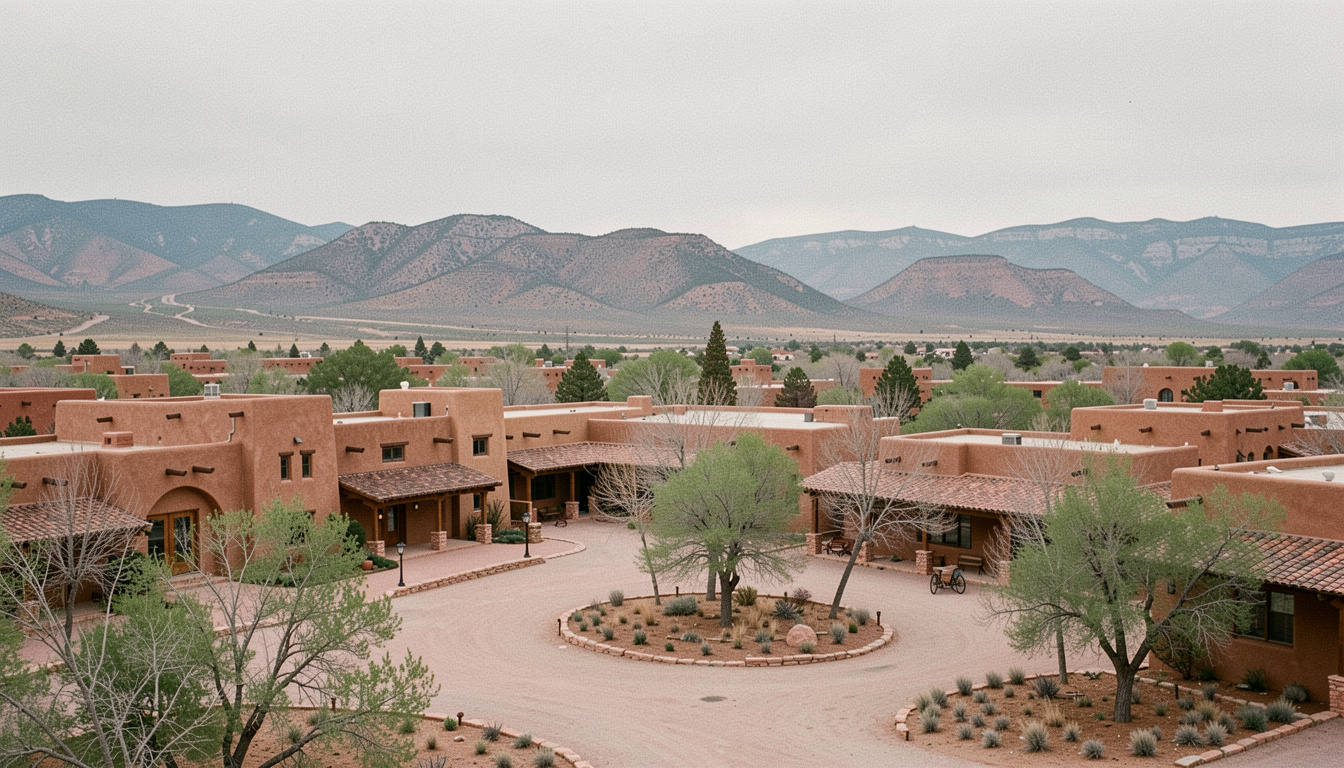
The Railyard is what a small city does with twenty-odd acres of disused railroad land: a park, a farmers market pavilion, a contemporary art space, an independent cinema, galleries and the terminus of the commuter train to Albuquerque. It is a ten-minute walk southwest of the Plaza and the part of town that feels least like a postcard.
The Santa Fe Farmers Market, running since 1968, fills the pavilion on Saturday mornings all year and adds days in season. It is a genuine growers' market: the rule is that vendors sell what they grow or make, within a defined radius. In late summer the roasters are going outside and the whole district smells of green chile, which is the strongest sensory argument for visiting Santa Fe in September.
Further south, out on Rufina Circle in a converted bowling alley, Meow Wolf's House of Eternal Return has been running since 2016: a walk-through art installation disguised as a narrative puzzle, ticketed with timed entry. It divides visitors sharply and books out on holiday weekends.
05 Outdoors without leaving town
You do not have to drive into the mountains to get above the city. Three options start within the city limits.
- Cross of the Martyrs. A paved switchback path climbs from Paseo de Peralta to a hilltop overlook in about ten minutes. Free, open, and the best view of the downtown roofline at sunset.
- The Dale Ball trails. Roughly 25 miles of signed, junction-numbered singletrack in the foothills, with trailheads at the top of Canyon Road, on Sierra del Norte and at Cerro Gordo. Rolling piñon and juniper country, easy to sample for an hour.
- The Santa Fe River trail and the Railyard Park. Flat, shaded, and the right speed for an acclimatization day.
Everything higher, steeper or above tree line belongs to the mountains chapter: hiking the Sangre de Cristo covers Atalaya, Aspen Vista, the Winsor Trail and the peaks over 12,000 feet, including the altitude arithmetic that makes those walks harder than their distances suggest.
06 Red or green
New Mexico is the only state with an official state question, adopted in 1996: red or green? It is asked of anything that can carry chile, which in practice is most of the menu. Red is made from dried, ripened pods; green from roasted fresh ones. They are not degrees of the same thing, they are different ingredients with different seasons, and the heat of either varies by crop and by year. Ask for "Christmas" and you get both, side by side.
Beyond chile, the regional plate is worth learning as vocabulary. Sopaipillas are puffed fried bread served with honey, doing the work that bread does elsewhere. Posole is hominy stewed slowly with pork and chile, standard at Christmas and New Year. Biscochitos, anise and lard shortbread, have been the official state cookie since 1989. Frito pie, chile ladled into a split bag of corn chips, is exactly what it sounds like and has a long Plaza pedigree.
One practical note: green chile season runs roughly August into October, and roasting drums appear at grocery stores and roadside stands. If you are staying long enough to cook, this is the one thing to buy in quantity and freeze. The extended stay chapter covers what that involves.
07 Day trips worth the driving
Northern New Mexico rewards driving, and the distances are deceptive: a fifty-mile trip on mountain roads is a half day each way once you stop. The table gives honest times.
| Destination | Distance | Drive one way | What it is |
|---|---|---|---|
| Bandelier National Monument | about 45 mi | 1 h | Ancestral Pueblo cavates and cliff dwellings in Frijoles Canyon, with ladders into carved rooms. A shuttle from White Rock is normally required in peak season, so check access before setting off. |
| Chimayó | about 30 mi | 45 min | El Santuario de Chimayó, an 1816 chapel and one of the most visited pilgrimage sites in the country, with a small room of holy earth. Weaving families work in the same village. |
| High Road to Taos | about 90 mi | 2 h 30 with stops | The mountain route through Chimayó, Córdova, Truchas, Las Trampas and Peñasco. Return on the Low Road along the Rio Grande for a loop. |
| Taos and Taos Pueblo | about 70 mi | 1 h 30 | The Pueblo is a UNESCO World Heritage Site and a living community; it closes to visitors for stretches of each year, so confirm before driving. |
| Pecos National Historical Park | about 30 mi | 35 min | The ruins of a large pueblo and its Spanish mission church, plus the Glorieta Pass battlefield of 1862. |
| Turquoise Trail (NM 14) | about 50 mi to Albuquerque | 1 h 15 | The back road south through Madrid, a coal town turned artists' village, and Cerrillos. Slower and far better than the interstate. |
| Abiquiú and Ghost Ranch | 50 to 65 mi | 1 h to 1 h 20 | O'Keeffe country: red and yellow cliffs, a working conference ranch with hiking, and the ticketed home and studio tour. |
| Ojo Caliente | about 50 mi | 1 h | Mineral springs used for centuries, developed as a soaking resort. Reserve. |
| El Rancho de las Golondrinas | about 15 mi | 20 min | A living history ranch on a Camino Real paraje, open seasonally with festival weekends. |
One caution that applies to all of them: several sites in the region are on Pueblo land or administered jointly with Pueblo governments, and access rules change without much notice. Confirm opening on the day rather than assuming, and take cash for entry fees at smaller sites. If your dates happen to fall on a feast day, the chapter on pueblo feast days sets out which pueblo is keeping which saint's day, and what visiting one asks of you.
08 Choosing between them
If you have one day, stay in town: the Plaza in the morning, Canyon Road after lunch. If you have two, add Museum Hill. If you have three and the weather is settled, take one day trip and accept that it is the whole day. If you are here for a market weekend, plan on doing very little else: the city fills, parking collapses and the pleasure is in the market itself.